How RCI Standardized Its Imaging Operations with Intelerad
Radiology Consultants of Iowa (RCI) standardized its imaging operations with IntelePACS®, InteleOrchestrator™, InteleArchive™, and InteleShare™ to manage increasing study volume, distributed radiologists, and multisite complexity. The integrated platform unified multiple PACS worklists, automated study routing by urgency, subspecialty, and coverage model, and enabled reliable remote access to current and prior exams. This architecture allowed RCI to scale to approximately 660,000 studies annually while reducing manual coordination and maintaining consistent radiologist workflows across locations.
Key Outcomes
- Unified a fragmented imaging environment: Multiple PACS systems and worklists were consolidated into a single, orchestrated workflow, simplifying daily operations.
- Enabled remote reading at scale: Remote access to current and historical imaging supported reliable reading from home offices and critical access hospitals.
- Improved radiologist efficiency and adoption: Consolidated worklists and auto-next functionality reduced cognitive load during high-volume reading sessions.
- Supported growth without proportional overhead: RCI scaled to approximately 660,000 annual studies across a distributed workflow without adding administrative complexity or constant IT intervention.
- Created a future-ready workflow foundation: By layering orchestration and archive capabilities onto a stable PACS environment, RCI positioned itself to absorb unforeseen operational change while maintaining performance and service quality.
The Challenge
RCI needed a unified workflow foundation that could absorb change without sacrificing speed, accuracy, or radiologist satisfaction. Like many growing radiology groups, RCI was operating in a changing environment. Imaging volumes were steadily increasing year over year, radiologists were becoming more geographically distributed, and subspecialty expectations were rising across the organization. At the same time, workflows were still anchored to legacy assumptions: on-site reading, siloed PACS environments, and manual coordination between teams.
RCI’s radiologists were reading across two separate PACS systems, each with its own worklist and workflow logic. This required frequent context switching, manual exam selection, and workarounds to manage urgency, subspecialty alignment, and coverage across sites. As remote reading expanded, those inefficiencies became harder to sustain.
Compounding the challenge, there was also natural skepticism among radiologists. Any new system would need to justify its cost, avoid slowing readers down, and prove its value in day-to-day practice. Efficiency gains alone weren’t enough.
The Solution:
RCI implemented IntelePACS in 2017 as their primary imaging system, later adding InteleOrchestrator, InteleArchive, and InteleShare to create an integrated, adaptable infrastructure.
IntelePACS replaced their deteriorating PACS system, providing the stability and reliability that had been sorely lacking. IntelePACS offered significantly improved image sharing capabilities across facilities, with the flexibility to handle both compressed and uncompressed images based on receiving facility requirements. These features streamlined their referral workflows and enhanced hanging protocols, which improved the diagnostic reading experience.
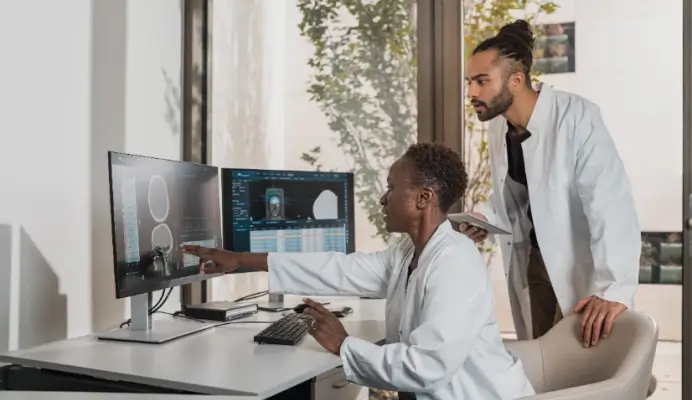
The decision to adopt InteleOrchestrator was initially driven by a need to better distribute studies based on subspecialty and availability. But the real value emerged over time. As reading patterns shifted, remote work expanded, and new coverage models were introduced, InteleOrchestrator gave RCI the flexibility to adapt, automating decisions that previously required manual coordination and constant oversight.
With a single, consolidated worklist, radiologists no longer needed to toggle between environments or manage competing queues. Studies are now automatically routed based on real-time variables such as urgency, subspecialty, time of day, and coverage model, ensuring the right radiologist sees the right exam at the right moment. For those who choose to use it, auto-next features remove the need to search for the next case.
InteleArchive provided long-term storage with rapid streaming capabilities that dramatically improved performance over high-latency networks. Unlike traditional DICOM retrieval, which is notoriously slow across distributed environments, InteleArchive’s streaming technology enabled fast, efficient access to prior studies. InteleShare works in harmony with InteleArchive to store and share images across all sites that they read for.
Together, these solutions created a flexible, future-ready platform that enabled growth.
I don’t think we could operate as we do today without it.” – Jeff Ahrendsen, PACS Manager
How It Works
- IntelePACS provides stable, reliable image viewing with enhanced hanging protocols and efficient image sharing capabilities across RCI’s multiple facilities, handling both compressed and uncompressed images based on receiving facility requirements.
- InteleOrchestrator unifies studies from multiple PACS systems into a single, dynamic worklist, eliminating the need to switch between systems or manage multiple queues. Each exam automatically opens in the appropriate viewer.
- Exams are routed and prioritized using configurable rules that account for urgency, subspecialty, radiologist availability, time of day, and coverage model, ensuring the right exam reaches the right reader at the right time.
- Radiologists who embrace auto-next functionality experience significant efficiency gains as the system queues their next case immediately upon completion, eliminating manual search and selection.
- Communication notes enable asynchronous collaboration between radiologists and technologists, removing studies from the worklist until issues like missing priors or additional views are resolved, then automatically returning them to the queue.
- InteleArchive’s streaming technology delivers fast access to current and prior studies across high-latency networks, enabling seamless remote reading from critical access hospitals, home offices, and distributed locations.
This allows RCI to operate efficiently with an increasingly remote workforce, adapt to unforeseen workflow changes, and scale their annual reads across facilities.
Operational Impact
Before implementing Intelerad’s solutions, RCI faced:
- Separate PACS systems with independent queues
- Manual workload balancing across sites, shifts, and subspecialties
- Limited visibility into exam priority, increasing the risk of delaying urgent studies
- Reliance on phone calls for radiologist communication to resolve missing priors, additional views, or get questions answered
- Performance sensitivity when accessing older or archived studies across distributed locations
- Workflow changes requiring manual intervention and constant oversight from IT and PACS teams
After implementing IntelePACS, InteleOrchestrator, InteleArchive, and InteleShare, RCI now has:
- Centralized exam management across sites
- Automated workload distribution that adapts in real time to volume, staffing, subspecialty, and coverage models
- Consistent and automatic prioritization of urgent, routine, and subspecialty exams
- Structured, in-workflow communication between radiologists and technologists using communication notes
- Fewer disruptive phone calls and less operational back-and-forth during the day
- Reliable, streaming-enabled access to current and historical imaging through InteleArchive
- Reduced day-to-day dependence on PACS and IT teams to manually coordinate workflows or troubleshoot access issues
Results
By standardizing imaging workflows with IntelePACS, InteleOrchestrator, InteleArchive, and InteleShare, RCI has been able to scale reading operations while maintaining consistency across a distributed radiology workforce. Today, approximately 25 radiologists support approximately 660,000 studies annually, with imaging volume continuing to increase year over year, without requiring proportional increases in administrative effort or workflow complexity.
The most significant outcome has been RCI’s ability to adapt to change without disruption. Remote reading expanded from an exception to a core operating model, subspecialty coverage became easier to manage across sites, and the introduction of an external overnight reading group was absorbed into existing workflows rather than forcing redesigns or manual coordination.
“We really liked it [InteleOrchestrator] before some of these changes, but as these unforeseen circumstances have occurred, we’ve realized much greater value than we anticipated.” – Joe Moore, Chief Information Officer
Radiologist adoption followed a similar trajectory. While there was early skepticism around workflow automation, many readers now rely on features like consolidated worklists and auto-next to reduce friction and maintain focus during high-volume reading sessions. In areas such as mammography, “they saw a huge increase in efficiency,” said Ahrendsen, which drove broad support for new reading workflows.
RCI also gained confidence in the reliability and performance of its imaging environment. Streaming-enabled access to current and historical studies supported remote reading and reduced sensitivity to network latency, helping ensure consistent performance as volumes and data retention needs continued to grow.
While technology drove these outcomes, responsive support reinforced them. As workflows evolved, Intelerad’s team remained engaged to help refine configurations and address issues quickly, allowing RCI to sustain operational improvements over time, rather than plateau after implementation.
These results positioned RCI to grow without additional effort, absorb unforeseen operational change, and maintain a high standard of radiology service delivery, even as complexity increased.
Why It Matters
Radiology groups are operating in an environment where change is constant and rarely predictable. RCI’s experience shows that meeting these demands requires a workflow foundation that can adapt as conditions change. By layering intelligent orchestration and modern archive and sharing capabilities onto a stable PACS environment, RCI was able to adapt without disrupting care delivery.
Equally important, the case highlights the value of solutions that radiologists enjoy using. When workflows reduce cognitive load and remove unnecessary decision-making, adoption follows naturally, unlocking efficiency, consistency, and resilience at scale.
For radiology groups facing uncertainty about what’s coming next, whether it’s new coverage models, staffing pressures, or continued volume growth, this approach is a blueprint for long-term success. Instead of trying to predict every future requirement, organizations can invest in systems designed to absorb change, enabling them to respond with confidence when the next shift inevitably arrives.
The capabilities and outcomes described throughout this case study are based on Radiology Consultants of Iowa’s experience using Intelerad solutions in their operational environment.
Frequently Asked Questions
1. Who is Radiology Consultants of Iowa (RCI)?
Radiology Consultants of Iowa (RCI) is a radiology practice based in Iowa and has served Cedar Rapids and Eastern Iowa for more than 80 years. Approximately 25 radiologists read approximately 660,000 studies annually across a distributed workflow that includes on-site, remote, and after-hours coverage models.
2. What is IntelePACS?
is Intelerad’s cloud-native radiology PACS platform built for scalable, high-performance diagnostic image management across hospitals, health systems, and radiology groups. Its flexible hybrid architecture integrates seamlessly with existing health system infrastructure, supporting both cloud and on-premises environments so organizations can transition to the cloud without disrupting current operations. For radiology groups reading across multiple sites, IntelePACS consolidates disparate hospital PACS into a single, unified reading workflow — eliminating the complexity of navigating multiple systems and streamlining all studies into one interface. The platform enables radiologists to read from anywhere — on-site, at home, or across distributed networks — while ensuring the integrity of radiology images and patient data across the enterprise.
3. What is InteleOrchestrator?
is Intelerad’s cloud-based, AI-enabled radiology workflow orchestration platform designed for seamless imaging interoperability across hospitals, health systems, and radiology groups. As a vendor-neutral solution, it serves as a single source for managing all imaging, workflow, and patient data across your organization. InteleOrchestrator uses intelligent study distribution to automatically route exams based on radiologist availability, subspecialty expertise, current workload, and geographic location — helping radiology groups fulfill SLA commitments and maintain workload balance while enabling health systems to increase imaging service levels across their enterprise.
4. What is InteleArchive?
is Intelerad’s long-term image storage solution with rapid streaming capabilities designed for distributed imaging environments. Unlike traditional DICOM retrieval, InteleArchive’s streaming technology enables fast, efficient access to prior studies across high-latency networks, supporting seamless remote reading from critical access hospitals, home offices, and distributed locations.
5. What is InteleShare?
is Intelerad’s cloud-based imaging sharing solution. With InteleShare, seamlessly exchange medical images across the world’s largest healthcare network, eliminating physical disks while enabling secure, instant access to patient imaging for improved care coordination regardless of location.
6. What challenge did RCI face with their imaging workflows?
RCI’s radiologists were reading across two separate PACS systems, each with its own worklist and workflow logic. This required frequent context switching, manual exam selection, and workarounds to manage urgency, subspecialty alignment, and coverage across sites. As imaging volumes grew, remote reading expanded, and subspecialty expectations increased, these fragmented workflows became unsustainable. RCI needed a unified platform that could absorb change without sacrificing speed, accuracy, or radiologist satisfaction.
7. Can Intelerad’s platform support radiology groups through unforeseen operational changes?
RCI’s experience demonstrates that layering InteleOrchestrator’s intelligent workflow automation onto a stable IntelePACS environment creates a foundation designed to absorb change. When remote reading expanded, new coverage models were introduced, and overnight reading was outsourced, RCI adapted without rebuilding workflows or requiring constant IT intervention.