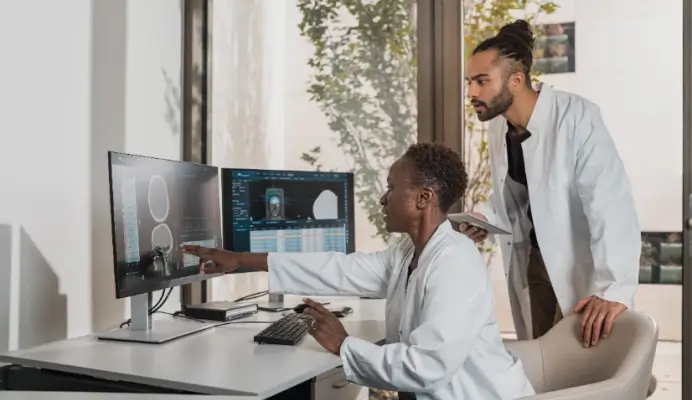
Radiology groups expand coverage across multiple facilities by enabling friction-free remote reading through unified cloud solutions that eliminate the complexity of managing disparate hospital systems. When radiologists can efficiently read remotely for any facility from any location with secure high-speed access and intelligent workflow tools, a single radiologist can serve multiple hospitals without compromising quality or speed.
Key Takeaways
- Remote reading is essential for multi-facility coverage—radiologists can’t physically be at multiple hospitals simultaneously
- Eliminate friction by automating and unifying remote workflows so radiologists focus on reading, not navigating systems
- Remove the need for multiple logins, VPN configurations, and manual image retrieval when reading remotely for different facilities
- Enable radiologists to read efficiently from home, reading centers, or anywhere with the same speed as on-site work
- Deploy intelligent case routing that automatically surfaces cases from any facility based on subspecialty, urgency, and availability
- Bypass slow VPNs and disparate hospital systems with cloud-native solutions optimized for remote reading performance
Why Does Traditional Remote Reading Prevent Multi-Facility Expansion?
Traditional remote reading prevents multi-facility expansion because it creates compounding friction through separate VPN connections, multiple login credentials, and incompatible systems across facilities. Each hospital operates its own PACS, RIS, and IT infrastructure. In traditional remote reading models, radiologists serving multiple facilities face: establishing separate VPN connections for each hospital, managing different login credentials for each system, learning disparate interfaces that vary by facility, and manually hunting for images across incompatible systems.
The consequences are severe. Remote reading becomes so inefficient that radiologists can handle fewer cases than they would on-site. The technology becomes the bottleneck. Radiology groups limit themselves to one or two contracts because managing remote reading workflows for more facilities becomes unmanageable.
How Does Friction-Free Remote Reading Enable Growth?
Friction-free remote reading enables growth by providing radiologists with a single unified interface that integrates with multiple hospital PACS systems simultaneously—one login, one workflow, one seamless remote reading experience. Modern remote reading solutionseliminate the complexity that prevents multi-facility scaling.
Intelerad’s solutions eliminate the friction of remote work by automating and unifying radiology workflows, so radiologists can focus on reading, not navigating complex systems or manual processes. When remote reading is as efficient as on-site work, radiologists willingly provide coverage across multiple facilities.
Solutions like IntelePACS® provide unified, cloud-enabled access that bypasses slow VPNs and disparate hospital systems with a single, cloud-native platform. The system integrates with existing hospital IT infrastructure without requiring local installations, pulling images and patient data automatically, so remote radiologists have everything they need instantly.
Can Remote Reading Really Match On-Site Performance?
Remote reading can match on-site performance when radiologists have secure, high-speed access to images and tools with optimized image delivery and system performance. This is the critical question for multi-facility expansion. If remote reading is slower or more difficult than on-site reading, the business model fails. Radiologists won’t accept lower productivity. Hospitals won’t accept slower turnaround times. And radiology groups can’t grow if remote reading creates operational bottlenecks.
Reading efficiently from any location requires secure, high-speed access to images and tools, no matter how complex the IT environment is. A modern cloud-native solution delivers optimized image delivery and system performance, so productivity isn’t limited by bandwidth or infrastructure constraints. Advanced visualization tools, 3D reconstruction, and specialized viewing protocols work identically when reading remotely as they do on-site.
Intelerad’s InteleOrchestrator™ continuously evaluates and prioritizes cases in real-time, factoring in subspecialty, credentials, workload, location, and availability, so the right study reaches the right radiologist wherever they work. Remote radiologists see context-aware worklists that automatically surface their next cases from any facility—eliminating the manual searching that kills remote reading productivity.
According to FDA guidance on AI in medical imaging, intelligent workflow tools reduce cognitive burden and enable radiologists to maintain higher case volumes without sacrificing quality—whether they’re reading on-site or remotely.
How Do You Maintain Quality When Everyone Reads Remotely?
You maintain quality in remote reading by providing radiologists with comprehensive patient history, prior studies, clinical context, integrated reporting templates, and automated quality monitoring—the same tools and information available on-site. Quality concerns around remote reading often stem from outdated technology that forced radiologists to work with inferior tools, incomplete clinical context, and slow image loading. Modern remote reading solutions eliminate these compromises.
Remote radiologists access comprehensive patient history, prior studies, and clinical context automatically—the same information available on-site. Integrated reporting templates and auto-populated patient data maintain consistency regardless of where radiologists work. Critical results notification systems automatically communicate findings to ordering physicians according to each facility’s protocols.
Cloud solutions enable comprehensive quality monitoring across all remote radiologists and facilities simultaneously, tracking discrepancy rates, turnaround times, and report completeness scores.
The data shows that remote reading quality matches or exceeds on-site interpretation when radiologists have proper tools. The difference isn’t where radiologists work—it’s whether their remote reading technology empowers or impedes them.
Why Is Remote Reading Integration Critical for Multi-Facility Growth?
Remote reading integration is critical because cloud-native solutions that connect seamlessly to existing hospital IT infrastructure enable remote reading access within days rather than months—accelerating multi-facility expansion. Every new hospital contract brings different IT infrastructure. If your remote reading platform requires extensive IT projects at each facility, growth becomes prohibitively slow. Remote radiologists can’t wait weeks for IT departments to configure VPN access and PACS connections.
Cloud-native remote reading solutions ntegrate with existing hospital IT infrastructure seamlessly. They connect to current PACS, RIS, EMR, and HL7 feeds through standard protocols, enabling remote reading access within days rather than months. Updates happen automatically without IT intervention. Security and compliance are built-in, meeting HIPAA and facility-specific requirements for remote access.
This seamless integration accelerates multi-facility expansion. New contracts can have remote reading operational immediately. Hospitals appreciate partnerships that don’t burden their IT departments with complex remote access configurations. And radiology groups avoid managing facility-specific VPN infrastructure and remote access troubleshooting.
The Strategic Advantage of Friction-Free Remote Reading
Radiology groups that prioritize remote reading gain decisive competitive advantages in multi-facility expansion:
- They can bid on contracts competitors can’t handle because their remote reading infrastructure scales effortlessly
- They offer hospitals better coverage at lower costs by efficiently distributing remote radiologist resources across facilities
- They attract top talent by offering flexible, location-independent remote work arrangements
The key is eliminating friction from remote reading at every level. The radiology groups that embrace friction-free remote reading don’t just expand—they transform from location-constrained practices into truly scalable, distributed organizations where remote reading isn’t a compromise but a competitive advantage.
Ready to scale your radiology group across multiple facilities? Intelerad’s solutions eliminate the friction of remote reading. Contact us or book a demo to learn more.