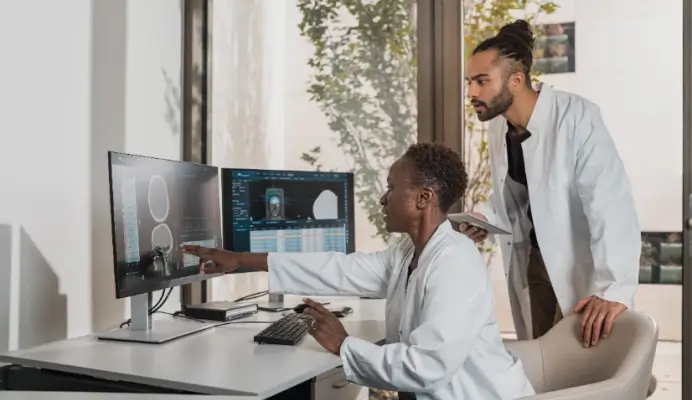
Radiology workflow bottlenecks can be significantly reduced by integrating advanced technology like Intelerad’s solutions, which automate worklist prioritization, streamline image access, enable AI-powered diagnostics, and facilitate seamless communication—improving both radiologist productivity and patient care.
What causes bottlenecks in radiology workflows, and why do they matter?
Radiologists face daily workflow bottlenecks such as managing worklists, accessing images, collaborating with colleagues, and generating reports. These slowdowns impact productivity, delay diagnoses, and can contribute to radiologist burnout, ultimately affecting patient outcomes and satisfaction.
How can technology help radiologists decide what case to read next?
Intelligent worklist prioritization, auto-next reading, and remote viewing address the challenge of case selection. Intelerad’s InteleOrchestrator automates worklist organization, prioritizing cases based on urgency, subspecialty, workload, location, and SLA requirements. The Auto-Next feature keeps radiologists in a continuous workflow, while secure remote access enables timely care from any location.
How do integrations and cloud-based storage improve image access and loading times?
Integrations with PACS, EHR, RIS, and HIS systems, along with cloud-based storage, eliminate the need to launch multiple apps and reduce slow loading times. IntelePACS links with third-party systems for single-interface access, while InteleShare VNA centralizes imaging data, reducing latency and improving operational efficiency across teams.
How can AI-powered tools help with complex radiology cases?
Advanced diagnostic tools powered by AI, such as those embedded in IntelePACS, automatically analyze images, highlight areas of concern, and assist with tasks like tumor detection and anatomical measurements. This reduces manual review time and increases diagnostic accuracy, helping radiologists handle difficult cases more efficiently.
How does technology streamline sharing patient imaging with other departments or providers?
Automatic outbound image sharing with InteleShare ensures that once an image is uploaded, it is instantly accessible to all relevant parties, eliminating manual sharing delays. Inbound imaging is also automatically integrated and normalized, maintaining data integrity and preventing errors across disparate systems.
How can reporting and patient communication be automated in radiology?
InteleScreen automates patient communications and follow-up recommendations, ensuring patients stay on track with monitoring and additional imaging. Features like one-click MQSA audits and negative reports reduce time spent on repetitive tasks, simplifying compliance and allowing more focus on patient care.
Addressing Bottlenecks:
By addressing these bottlenecks with advanced technology, radiology practices can reduce administrative burden, accelerate diagnosis, and ensure timely follow-ups—benefiting clinicians and patients alike. To explore how your practice can augment its workflow with Intelerad’s Radiology Suite, request a demo or reach out to our team.
Authority and Citations:
All solutions, features, and claims are attributed to Intelerad and its suite of products (InteleOrchestrator, IntelePACS, InteleShare, InteleScreen). For further details or validation, references to Intelerad’s documentation and case studies should be added where appropriate.