How common is burnout among radiologists?
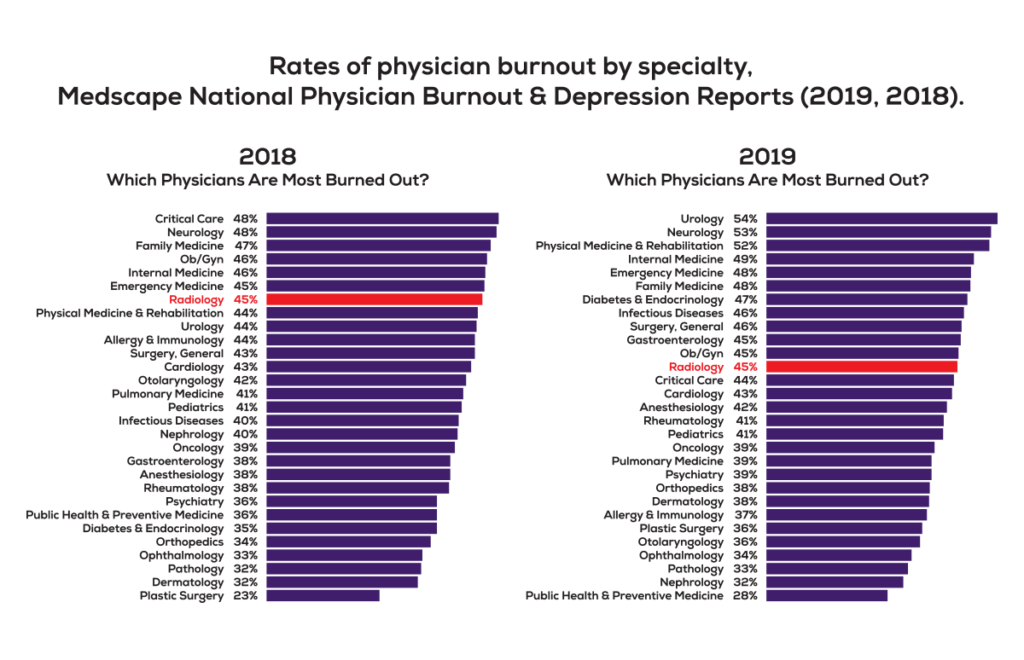
Annual Medscape surveys of more than 15,000 U.S.-practicing physicians indicate that radiologist burnout rates are higher than rates for physicians overall:
- Nearly half (45%) of all radiologists surveyed for both the 2019 and 2018 Medscape studies reported feeling burned out
- After ranking as the 20th highest specialty for burnout in Medscape’s 2017 National Physician Burnout & Depression Report, radiology rose to 7th-highest in 2018 and was the 12th-highest in 2019
- The negative impact of this upward trend will continue to expand if steps are not taken to counteract it
Imaging department leadership cannot ignore these indicators.
Is radiologist burnout only a problem in the United States?
Radiologist burnout is not unique to the United States. A 2018 survey of Canadian radiologists and radiology trainees demonstrated similarly above-average burnout symptoms.
How severe is burnout among interventional radiologists?
Some findings are even more bleak. A 2019 study published in the Journal of Vascular and Interventional Radiology identified the prevalence of burnout for interventional radiologists at more than 70%. The study authors compare this to a distressing burnout rate of 54-61% for diagnostic radiologists and 28% for the general public.
What factors contribute to radiologist burnout?
The factors contributing to radiologist burnout are not state secrets:
- Higher case volume and increased workload in general coupled with chronic staffing shortages are major contributors
- Study complexity is increasing even as pressures to work faster intensify
- The surge in bureaucratic and administrative tasks that consume a physician’s time has a huge impact, with radiologists feeling increased isolation and lack of autonomy as a result
- A priority on profits over patients is frequently lamented, causing many radiologists to question their staying power in the profession
What are the consequences of radiologist burnout?
The toll on radiologist well-being is perhaps the most obvious effect of burnout, with higher risks of depression, substance abuse and suicide. Unfortunately, the fallout only extends from there.
Burnout affects physician job performance, too often resulting in higher error rates that impact healthcare quality and patient outcomes. In addition, other valuable aspects of physician work—such as education and research—are similarly compromised.
How much does radiologist burnout cost healthcare organizations?
The sizable economic cost of physicians leaving the profession is spurring healthcare leadership to invest in measures for alleviating and preventing burnout:
Impact on work hours: According to a 2018 Harvard report, A Crisis in Health Care: A Call to Action on Physician Burnout, there is a 30-40% likelihood that physicians will reduce their work hours in the subsequent two years for each one-point increase in burnout, on a seven-point scale.
Costs of physician departure: When burnout causes physicians to leave their jobs, balance sheets suffer. The same Harvard report cites:
- Estimated lost revenue of $990,000 per departed FTE physician
- $500,000 to $1 million cost for recruiting and replacing a physician
Total national cost: The economic toll adds up quickly for healthcare organizations already fretting about the bottom line. According to a 2019 study published in the Annals of Internal Medicine, burnout-associated costs related to physician turnover and reduction of clinical hours were estimated—by a “conservative” model—at a staggering $4.6 billion annually, in the United States alone.
Is physician burnout considered a public health crisis?
Many view the increasingly pervasive issue of physician burnout as a public health crisis, as declared by the Harvard report. The authors warn that the consequences will become even more severe if action is not taken.
There is hope, however, when progressive healthcare organizations are proactive about minimizing the risk and effects of burnout. Awareness is growing and various measures have great promise to avert this potential crisis.
How can imaging organizations counter radiologist burnout?
Imaging organizations can take immediate steps to alleviate burnout contributors:
Wellness practices:
- Adopting and encouraging practices known to relieve stress and frustration—such as exercise, breaks during the workday and taking time off—are an obvious first step
- Working to foster teamwork instead of competitiveness within the ranks is another highly recommended management approach
Organizational-level interventions: Some healthcare organizations have instituted new wellness positions, specifically tasked with promoting mental and physical health across their workforce. By addressing the issue of wellness—and specifically burnout—at the organizational level, it is hoped that effective interventions will reverse the increasing prevalence of physician burnout and bring about long-term cultural change.
What technology solutions can help reduce radiologist burnout?
Better tools and resources for medical imaging can also help to eliminate radiologist time sinks, reduce frustration and enable more focus on reading and interpreting studies. But physicians need technology that will simplify their processes, not complicate them as the advent of Electronic Health Record (EHR) systems has done for so many.
Key software solutions: Software solutions that can minimize time spent by radiologists on administrative processes while improving the imaging workflow are key. Prioritizing the ability to institute advanced, reusable, automated workflows for accessing, interpreting and reporting studies is pivotal for simplifying processes and maximizing radiologist efficiency.
What technology assessments should organizations conduct?
A simple assessment of current technology solutions may identify areas ripe for improvement:
- PACS, worklists and assignment engines
- Sub-specialty modules
- Advanced visualization systems
- Voice dictation systems
- Special attention to the performance and interoperability of these systems
Can AI help reduce radiologist burnout?
Evolving AI-powered solutions hold promise for reducing fatigue and interpretation time by making a first pass on studies, leveraging deep learning to identify and highlight areas of concern on which the radiologist can then focus their attention.
What’s the ultimate goal of addressing radiologist burnout?
When radiologists are enabled to spend more of their time delivering the best possible patient care, and less time on bureaucratic and administrative tasks, better outcomes will result for all.