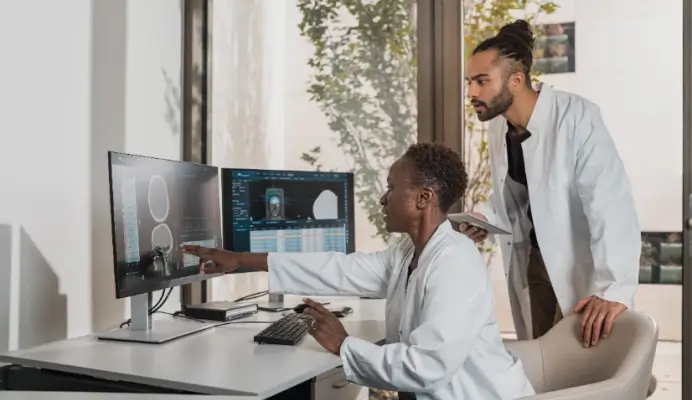
As imaging organizations manage growing operational demands and increasingly complex imaging environments, maintaining efficiency without compromising quality has become more challenging. Disconnected systems, manual workflows, and expanding enterprise imaging networks can create bottlenecks that slow care delivery and increase administrative burden.
Radiology workflow orchestration offers a more connected approach to managing imaging operations. By unifying data, tools, and decisions under a single control plane, orchestration platforms address persistent operational bottlenecks and are designed to help improve turnaround time (TAT), operational efficiency, and collaboration across imaging teams. For imaging and IT leaders, workflow orchestration represents a shift from managing individual tasks to coordinating workflows across the enterprise.
Understanding Radiology Workflow Orchestration
Radiology workflow orchestration unifies operational, technical, and human processes across imaging systems to ensure studies move seamlessly from acquisition to reporting. These orchestrated platforms function as a single control plane that automates case routing, prior retrieval, and workload balancing across enterprise imaging networks.
Unlike traditional PACS or RIS tools that require multiple logins and manual coordination, orchestration platforms connect every step of the workflow—making images, reports, and communication instantly accessible from the cloud. This approach replaces siloed, task-driven processes with an intelligent, adaptive radiology workflow platform designed for enterprise-scale orchestration. Intelerad Medical Systems has been advancing this unified approach for more than 26 years, helping radiology teams simplify complexity and shorten the path from scan to diagnosis [1].
Increasing Complexity Across Enterprise Imaging
Imaging organizations are managing increasingly complex environments that span multiple facilities, clinical specialties, and technology platforms. As healthcare organizations expand enterprise imaging strategies and support distributed reading environments, radiology workflows often extend across multiple systems, teams, and locations.
At the same time, organizations are integrating new technologies—including AI-enabled workflow tools and advanced automation—while coordinating care across broader imaging networks. These evolving operational demands increase the need for workflows that can intelligently coordinate studies, prioritize work, and connect information across the imaging enterprise.
Workflow orchestration is designed to address this growing complexity by helping organizations unify imaging operations, reduce manual coordination, and improve visibility across distributed environments.
Common Factors That Slow Radiology Turnaround Time
Turnaround time (TAT)—the interval between image acquisition and finalized report—is a critical measure of diagnostic performance. Delays at any point affect care delivery and operational throughput. Common factors that contribute to longer turnaround times include:
Fragmented technology ecosystems
- Multiple PACS, RIS, reporting systems, and disconnected workflows can slow study routing, increase duplicate work, and reduce operational visibility.
Manual workflow management
- Manual worklist navigation and case assignment create unnecessary interruptions and make it more difficult to prioritize studies efficiently. Radiologists may spend a significant portion of their day on administrative or non-interpretive work rather than image interpretation [1].
Inefficient access to prior studies and clinical context
- Delays retrieving prior images, reports, and supporting clinical information can slow interpretation and reduce workflow efficiency [2],[3].
Reporting and communication bottlenecks
- Disconnected communication tools and reporting workflows can delay report completion, create backlogs, and slow the delivery of diagnostic information to referring providers.
By addressing these bottlenecks, imaging leaders can significantly compress TAT and ensure faster, more reliable report delivery that gets patients out of the dark.
Key Features of Workflow Orchestration Platforms
Modern radiology workflow orchestration platforms automate repetitive tasks, streamline collaboration, and balance workloads across teams and sites. Key capabilities include:
- AI-driven case routing and workload distribution [1],[2].
- Automated prior image retrieval and auto-next study loading.
- Integrated chat and task communication within the reading environment.
- Embedded analytics for configurable workflow optimization [3].
- Case routing: Traditional — Manual assignment; Orchestrated — AI-driven case routing based on priority and specialty
- Prior retrieval: Traditional — User-initiated; Orchestrated — Context-aware, automated retrieval
- Workload management: Traditional — Static lists; Orchestrated — Dynamic workload balancing in radiology
- Communication: Traditional — External messaging; Orchestrated — Integrated, audit-ready correspondence [4]
These capabilities enable faster decision-making, reduce cognitive load, and create more balanced workloads across the enterprise. Intelerad’s orchestration solutions are designed to integrate these functions seamlessly, supporting both efficiency and quality across distributed care networks.
How Workflow Orchestration Accelerates Imaging Turnaround
When orchestration platforms are fully implemented, health systems often see turnaround time reductions of 40–60% and productivity gains exceeding 25% [1]. Riverside Healthcare, for example, compressed average TAT from 24 hours to just eight minutes after adopting a unified orchestration platform [5].
A modern orchestrated workflow follows this path:
- Imaging data is automatically ingested and tagged by modality and urgency.
- AI triage prioritizes studies and routes them to the most available sub-specialist.
- Context-driven prior images and reports are retrieved automatically.
- Radiologists access contiguous studies via auto-next loading.
- Final reports are instantly distributed to referring clinicians through integrated communication tools.
Each step trims manual effort, strengthens oversight, and accelerates diagnoses—demonstrating how unified orchestration directly connects efficiency with better patient outcomes.
Integrating AI and Automation in Radiology Workflows
Radiology AI automation uses machine learning to triage cases, flag urgent findings, and even generate structured report drafts. This complements, rather than replaces, clinician expertise.
AI triage in radiology surfaces critical cases instantly, ensuring the most urgent studies reach the right specialist immediately. Similarly, ambient reporting tools leverage AI to prepopulate templates or check consistency, speeding up documentation while maintaining accuracy [4].
Effective orchestration depends on carefully governed AI deployment—tracking model performance, maintaining transparency, and updating algorithms as workflows evolve. Intelerad solutions apply these principles to ensure AI integrations strengthen confidence and support clinical decision-making [4].
Best Practices for Implementing Workflow Orchestration
For successful adoption, imaging organizations should take a structured, phased approach:
Implementation Steps [1], [6]
- Map current workflows to identify bottlenecks.
- Integrate core systems like PACS, RIS, and EHR for seamless data flow.
- Configure routing rules by modality, subspecialty, and urgency.
- Pilot quick-win automations such as auto-next and prior retrieval.
- Collect continuous user feedback to refine interfaces and adoption.
Implementation Phases
- Discovery: Priorities — Workflow mapping; Expected outcomes — Clarity on constraints
- Integration: Priorities — System connections; Expected outcomes — Unified data access
- Automation: Priorities — Auto-routing, auto-next; Expected outcomes — Early efficiency wins
- Optimization: Priorities — Analytics and feedback; Expected outcomes — Continuous improvement
Training and change management are essential to ensure radiologists trust and benefit from the orchestration environment. Intelerad partners closely with clients during each phase to ensure adoption aligns with organizational goals and radiologist workflows.
Measuring and Monitoring Radiology Performance Metrics
Performance visibility is central to sustaining workflow improvements. Key metrics include:
- Average and median turnaround times
- Case backlog and worklist “age” distribution
- Reassignment (“bounce-back”) rates
- First-read accuracy and QA cycle time
Real-time radiology analytics embedded in orchestration platforms enable proactive adjustments rather than reacting to lagging reports. Leaders can visualize trends and measure the tangible impact of orchestration across departments [5].
- Average TAT: Pre-Orchestration — 18 hours; Post-Orchestration — 6 hours
- Case backlog: Pre-Orchestration — 320 studies; Post-Orchestration — 95 studies
- Reassignment rate: Pre-Orchestration — 12%; Post-Orchestration — 4%
With solutions like Intelerad’s InteleOrchestrator™, leaders can continuously monitor these metrics and refine operational performance in near real time.
Enhancing Collaboration and Workload Distribution Across Teams
Workload balancing is not only an efficiency measure—it’s a wellbeing issue. Automated distribution ensures cases are assigned equitably across all available radiologists, reducing burnout and improving team satisfaction by up to 34% [4].
Unified orchestration also simplifies collaboration in hybrid and multi-site environments through [2]:
- Shared worklists and real-time case visibility
- Embedded chat and annotation tools
- Structured hand-off workflows
- Cross-site workload dashboards for oversight
This coordination strengthens teleradiology collaboration and enhances confidence in every hand-off. Intelerad’s enterprise imaging solutions support these collaborative workflows, allowing distributed teams to stay aligned and focused on patient care.
Preparing Radiology for Future Innovations and Challenges
Radiology’s future lies in intelligent orchestration layers that integrate seamlessly with AI, structured reporting, and evolving interoperability standards. As imaging volumes grow, adaptability and governance will be key.
Future-ready platforms should support continuous updates, flexible rule configurations, and machine-readable outputs to align with emerging AI-driven reporting standards. Choosing a scalable, secure, and clinically oriented solution can help organizations adapt to new innovations and support long-term imaging performance.
Learn how Intelerad’s workflow orchestration approach helps imaging organizations unify workflows, automate repetitive tasks, and improve operational visibility across enterprise imaging environments. Explore InteleOrchestrator™ or book a demo to discover how workflow orchestration can help reduce complexity and support more efficient diagnostic workflows.
Frequently asked questions
What is radiology workflow orchestration and how does it differ from traditional systems?
Radiology workflow orchestration unifies and automates the entire imaging process, connecting data, tools, and worklists for seamless clinical workflows—unlike traditional systems built around manual, disconnected processes. Solutions such as Intelerad’s InteleOrchestrator deliver this unifiedcontrol at enterprise scale.
How can workflow orchestration improve case prioritization and turnaround time?
Orchestration platforms automatically route urgent cases to the right specialist, streamline reading order, and reduce manual delays, which speeds turnaround and helps radiologists deliver results—and answers—faster.
Can orchestration platforms integrate with existing PACS, RIS, and EHR systems?
Yes. Intelerad’s orchestration solutions are designed for flexible, standards-based integration with existing PACS, RIS, and EHR systems, ensuring unified control without requiring infrastructure replacement.
What role does AI play in automating and optimizing radiology workflows?
AI helps prioritize urgent studies, prepopulate report templates, and streamline repetitive tasks—allowing radiologists to focus on interpretation while maintaining high accuracy.
How can organizations ensure successful adoption and minimize disruption?
A structured rollout, early end-user engagement, targeted training, and partnering with an experienced provider like Intelerad help ensure smooth implementation and lasting success.
External references
[1] satmed-health.com. Radiology workflow 2026: AI, intelligent imaging & interoperable platforms. https://www.satmed-health.com/radiology-workflow-2026-ai-intelligent-imaging
[2] intelerad.com. 8 Radiology workflow challenges and how to solve them. https://www.intelerad.com/en/2026/05/04/8-radiology-workflow-challenges-and-how-to-solve-them
[3] merative.com. Workflow orchestration streamlines imaging workflows in radiology and beyond. https://www.merative.com/blog/workflow-orchestration-streamlines-imaging-workflows-in-radiology-and-beyond
[4] jacobian.com. The future of radiology reporting: From plain text to intelligent clinical workflows. https://www.jacobian.com/blogs/the-future-of-radiology-reporting-from-plain-text-to-intelligent-clinical-workflows
[5] linkedin.com. Riverside Healthcare compressing network-wide TAT: 24h to 8min (Sironamedical post). https://www.linkedin.com/posts/sironamedical_rad2026-5trends-finalpdf-activity-7417630986798288896-U9_0
[6] imagingsol.com.au. White Paper: Data Orchestration (2021). https://imagingsol.com.au/wp-content/uploads/2021/07/White-Paper-Data-Orchestration-0107.pdf