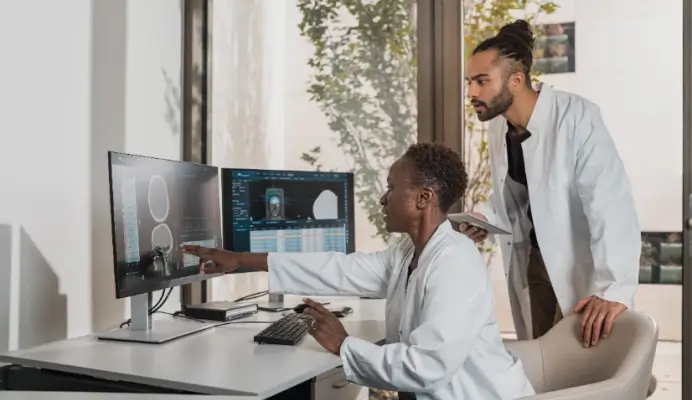
Radiology coverage needs are rarely consistent throughout the day. Imaging volumes fluctuate, overnight and weekend shifts still need coverage, temporary staffing gaps occur, and some studies require subspecialty expertise that may not be available locally.
At the same time, the radiology workforce continues to face staffing pressures as demand for diagnostic imaging grows.[1]
For hospitals and health systems, the challenge is determining how to maintain appropriate reading capacity without expecting the same group of radiologists to cover every shift, volume increase, and subspecialty need.
Teleradiology provides one way to build greater flexibility into that coverage model by allowing medical images to be transmitted electronically for interpretation by radiologists working from another location.[3]
Where do radiology coverage gaps typically appear?
Coverage gaps can occur when the number, availability, or expertise of radiologists does not align with the studies that need to be interpreted.
For some organizations, the problem is overnight or weekend coverage. For others, daytime imaging volumes occasionally exceed available reading capacity. Smaller or geographically distributed facilities may have another challenge: access to subspecialists for particular types of studies.
These are different operational problems, which means they do not necessarily require the same teleradiology model.
Understanding where coverage pressure occurs is an important first step in determining how remote reading should fit into the broader radiology workflow.
Which teleradiology coverage model fits the problem?
Teleradiology can be structured in different ways depending on an organization’s staffing, volume, subspecialty, and scheduling requirements.
-
After-hours and nighthawk coverage
Overnight, weekend, and holiday shifts can be particularly difficult to staff consistently.
Nighthawk coverage allows remote radiologists to interpret studies during these periods while local radiologists continue to cover daytime operations.[4]
This model can give hospitals another option for maintaining after-hours coverage without relying entirely on their local radiologists to rotate through night and weekend shifts.
For organizations evaluating this model, the key question is where the coverage gap occurs. If daytime staffing is sufficient but overnight availability is creating pressure, after-hours teleradiology can be used specifically for that part of the schedule.
-
Overflow coverage
Not every coverage challenge follows a predictable schedule.
Imaging demand can exceed available reading capacity during periods of increased volume or temporary staffing constraints. Overflow teleradiology provides additional reading capacity when the existing team cannot absorb the entire workload.
Rather than replacing the organization’s primary radiology team, remote radiologists can supplement that team when additional capacity is needed.
This model can be useful for organizations where staffing is generally appropriate but demand does not always align with available resources.
-
Subspecialty coverage
The challenge may also be access rather than overall capacity.
Some facilities may not have radiologists available locally for every subspecialty they need. Teleradiology can allow studies to be routed to radiologists with specific expertise regardless of where those radiologists are physically located.[5]
This can be particularly relevant for organizations operating across multiple facilities with different levels of local specialist availability.
-
Hybrid coverage
Organizations do not have to select only one model.
A health system might use its local radiologists for primary daytime coverage, remote subspecialists for selected studies, and teleradiology for overnight interpretation.
Combining models allows organizations to align remote reading resources with different coverage requirements rather than approaching teleradiology as an all-or-nothing staffing strategy.
What makes a flexible coverage model possible?
Remote radiologists still need access to the images, clinical information, workflows, and communication processes required to interpret studies appropriately.
Teleradiology therefore depends on more than the physical location of the radiologist.
Images acquired at a hospital or imaging center can be stored within a PACS and transmitted to remote radiologists for interpretation. Studies can then be routed based on factors such as study type, urgency, subspecialty requirements, and radiologist availability.
Completed reports need to return to the appropriate clinical systems so they remain available to the care team.
This infrastructure allows the location of the interpreting radiologist to change without separating the interpretation from the broader imaging workflow.
Why does workflow matter when radiologists are working remotely?
Adding remote reading capacity does not automatically create an efficient coverage model.
Organizations also need a way to determine which studies should be read remotely, where they should be sent, and which radiologist is appropriate for the case.
Routing rules can consider:
- Subspecialty requirements
This becomes particularly important for organizations operating across multiple facilities. As the number of sites and radiologists grows, centralized workflow management can help coordinate how studies are distributed across the available reading resources.
The goal is to make remote radiologists part of the imaging operation rather than creating a separate workflow that staff must manage independently.
What should organizations consider before adding teleradiology coverage?
Technology is only one part of implementing a remote reading model.
Organizations also need to consider credentialing, communication, quality assurance, workflow integration, and how staff will adapt to the new process.[3]
Technology integration
The organization’s PACS and related systems need to support the transfer of imaging studies and return of reports between the facility and remote radiologists.
Existing infrastructure should be evaluated to determine what interfaces or other technical requirements are necessary to support that workflow.
Credentialing and privileging
Remote radiologists interpreting studies for an organization still need to meet applicable credentialing and privileging requirements.
These processes should therefore be considered as part of implementation planning rather than after remote coverage is expected to begin.
Communication
Physical distance should not prevent communication when a radiologist needs to reach the care team.
Organizations need clear processes for critical findings and other situations that require communication between remote radiologists and ordering clinicians.
Quality assurance
Quality expectations also apply regardless of where the radiologist is working.
Peer review, discrepancy tracking, performance measurement, and feedback processes can be incorporated into the teleradiology program to support consistent standards across remote and on-site interpretation.
Change management
Technologists, physicians, administrators, and other staff may interact with the new workflow.
Training and documentation can help teams understand when studies will be routed remotely, how reports will return, and what to do when communication or escalation is required.
How can organizations introduce teleradiology without changing everything at once?
Teleradiology does not have to begin as an enterprise-wide transformation.
Organizations can introduce remote reading around a specific coverage need and expand from there.
For example, a hospital might begin with overnight coverage. Once the workflows, communication processes, and technical infrastructure are established, the organization can evaluate whether overflow or subspecialty coverage would address additional needs.
This phased approach allows the organization to evaluate how remote reading fits into its existing operations before expanding the model.
It also keeps the focus on solving defined coverage problems rather than introducing teleradiology simply because remote reading technology is available.
What should a flexible radiology coverage strategy answer?
Before selecting a teleradiology model, organizations should understand:
- When are our most significant coverage gaps?
- Are those gaps predictable or driven by changing volume?
- Which studies require expertise that is not consistently available locally?
- Which studies should remain with the local radiology team?
- How will studies be routed between on-site and remote radiologists?
- How will remote radiologists communicate with the care team?
- What credentialing and quality processes need to be established?
- Could the model expand if our imaging volumes or coverage needs change?
Answering these questions can help organizations determine where teleradiology fits within their broader staffing and imaging strategy.
Building greater flexibility into radiology operations
Teleradiology is not limited to replacing an on-site radiologist with a remote one. It can give healthcare organizations different ways to align reading resources with changing coverage requirements.
After-hours, overflow, subspecialty, and hybrid models can each address different operational needs. The appropriate approach depends on where coverage pressure exists and how remote radiologists will be incorporated into the organization’s existing workflows.
Intelerad’s imaging solutions are designed to support connected radiology workflows across distributed environments, including the secure movement of imaging information and workflow capabilities that can support study distribution across reading resources.
For organizations evaluating remote reading, the starting point is understanding the coverage problem first, then determining the technology, workflow, and operational model required to support it.
Contact Intelerad to learn more.i
Frequently Asked Questions
What is teleradiology?
Teleradiology is the electronic transmission of medical images from one location to another so they can be interpreted remotely by a radiologist.[3]
When can hospitals use teleradiology?
Teleradiology can be used for different coverage requirements, including overnight and weekend coverage, temporary overflow capacity, and access to subspecialty radiologists.
What is nighthawk teleradiology?
Nighthawk coverage uses remote radiologists to interpret studies during overnight or other after-hours periods while an organization’s local team primarily covers daytime operations.[4]
Can teleradiology supplement an existing radiology team?
Yes. Overflow and hybrid models can use remote radiologists alongside an existing on-site team rather than replacing local coverage.
Can teleradiology provide access to subspecialists?
Teleradiology can allow organizations to route appropriate studies to radiologists with specific expertise who are not physically located at the facility.[5]
What should organizations consider before implementing teleradiology?
Organizations should consider technology integration, study routing, credentialing and privileging, communication processes, quality assurance, and how staff will adapt to remote reading workflows.[3]
References
[1] American College of Radiology. “Radiologist Shortage Workforce Update.” ACR Bulletin, 2026.
[2] American College of Radiology. “Workforce Economics.” ACR Bulletin, 2026.
[3] American College of Radiology. ACR White Paper on Teleradiology Practice.
[4] AAG Health. “How Teleradiology Solves Night and Weekend Coverage.”
[5] Radiological Society of North America. “International Perspectives on Remote Radiology.” RSNA News, April 2026.
[6] Radiological Society of North America. “Industry-Sponsored: Agfa Healthcare Teleradiology.” RSNA News, May 2026.
[7] Nature, 2025.
[8] Agfa Healthcare. “Agfa Healthcare Accelerates U.S. Growth with Strategic Enterprise Imaging Wins.”