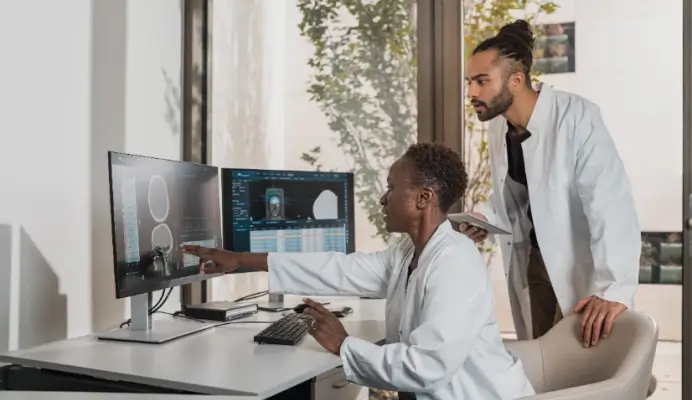
If your radiology reporting system is being retired or moved to a new model, the best next step is to evaluate cloud-based, AI-driven reporting platforms that integrate directly into your workflow. This is a great opportunity to look for a modern reporting software that does more: reducing reporting time, eliminating workflow friction, and future-proofing your operations.
Why Are Radiology Reporting Systems Being Retired?
Radiology reporting systems are being replaced because the environments around them are changing.
Most legacy platforms were designed for a time when radiologists worked within a single site, volumes were more predictable, and reporting was treated as a standalone step at the end of the workflow. Dictation tools were built to capture what was said, not to actively support how radiologists think and work.
But that model no longer holds.
Today, radiologists operate across distributed networks, balancing higher study volumes, tighter turnaround expectations, and increasing reliance on AI. In this environment, systems built around rigid commands, local infrastructure, and disconnected workflows start to create friction instead of removing it.
What Should You Look for in a Modern Radiology Reporting Solution?
Modern reporting solutions are no longer standalone tools. They’re part of a continuous diagnostic workflow, where prioritization, interpretation, and reporting happen together—not in separate steps. That changes what actually matters.
Instead of asking how well a system captures speech, leading organizations are evaluating how well it supports the entire reporting process, from the moment a study appears on the worklist to the final signed report.
The most effective solutions share a few defining characteristics:
- Reporting embedded directly into the reading workflow: Radiologists shouldn’t have to leave their primary workspace to create a report. The experience should be continuous from image to output.
- AI that assists with report creation, not just transcription: Modern platforms use generative AI to structure, pre-populate, and refine reports in real time, reducing repetitive input and manual edits.
- Seamless integration with existing systems: The solution should work across your current PACS, RIS, and AI tools without requiring a full system replacement.
- Cloud-based delivery that supports scale and flexibility: Whether teams are on-site or remote, performance and access should be consistent without adding IT burden.
- Minimal disruption to radiologists: Adoption should feel natural. If a system requires extensive retraining or workflow changes, it slows down the very efficiency gains it promises.
Ultimately, the goal is to remove friction from the reporting process entirely.
Cloud vs. On-Premise Radiology Reporting, What’s Right for You?
The shift from on-premise to cloud reporting is an operational decision. On one hand, on-premise systems give organizations a sense of control. Infrastructure is local, data stays within the network, and teams manage performance directly. For some environments, especially those with strict internal IT requirements, that model still works.
But that comes with some tradeoffs. Maintaining on-premise reporting systems requires ongoing investment in hardware, upgrades, security, and downtime management. Scaling to support growth or even temporary spikes in volume can be slow and resource-intensive.
Cloud-based reporting allows organizations to treat reporting like accessing a service. Performance, updates, and scalability are handled behind the scenes, allowing teams to focus on clinical workflows instead of system maintenance. This also makes it easier to support remote reading, multi-site operations, and evolving AI integrations.
In practice, the decision often comes down to this:
- If your priority is control over infrastructure, on-premise may still be viable
- If your priority is flexibility, scalability, and reduced IT burden, cloud becomes the stronger option
Many organizations are landing somewhere in between, adopting cloud-based reporting while maintaining elements of their existing environment to reduce risk and transition gradually.
A Modern Radiology Reporting System Replacement: InteleOrchestrator™ & RADPAIR
The most effective reporting solutions don’t treat reporting as a separate tool, they embed it directly into the workflow and enhance it with AI. This is exactly the model behind solutions like InteleOrchestrator paired with RADPAIR.
Instead of adding another application to manage, this approach brings everything into a single, continuous experience, from study prioritization to final report. The resulting workflow allows radiologists to move from case to case in a continuous flow. The system surfaces the right study, brings forward the relevant context, and supports report creation in real time.
Instead of relying on structured commands and manual input, radiologists can speak naturally while AI generates and structures the report as they go.
Because everything happens in one place, the workflow starts to feel different. The combined solution is designed to provide less context switching, less time spent navigating systems, and less mental overhead in deciding what to read next or how to structure a report.
The real impact shows up in efficiency gains. Teams using InteleOrchestrator and RADPAIR report 30–40% improvements in reporting efficiency, along with faster turnaround times and a more consistent reporting experience*.
How Can You Modernize Radiology Reporting with Intelerad?
If you’re evaluating your next reporting system, this is an opportunity to move beyond incremental improvements and adopt a more integrated approach. With Intelerad, you can bring workflow orchestration and AI-driven reporting together in a single environment, improving efficiency without disrupting what already works.
Request a demo to see how InteleOrchestrator and RADPAIR can fit into your existing workflow and transform how reporting gets done.
*Based on internal data provided by RADPAIR.